



- Specialty Rule Systems: Behavioral health claims face heightened denial rates due to strict DSM-5-TR diagnostic precision, unique prior authorization protocols, and ForwardHealth compliance rules.
- High Diagnostic Specificity: Major depressive disorder alone contains over 30 billable ICD-10-CM codes based on episode type, severity, remission status, and comorbidities.
- Federal Parity Protections: The MHPAEA mandates equal treatment between mental health and medical benefits, preventing payers from enforcing more restrictive prior authorization or copays.
- Proactive RCM Workflows: Pre-service verification, pre-billing chart audits, and automated scrubbing drop mental health denials by 25–35% within 90 days.
Table of Contents
- 1. What is Mental Health Medical Billing?
- 2. Why Mental Health Billing Fails in Wisconsin, The Core Challenge
- 3. How does mental health billing differs from medical billing?
- 4. The 6-Step Coding Process for Wisconsin Mental Health Claims
- 5. Prior Authorization for Mental Health Services in Wisconsin
- 6. Mental Health Parity Compliance in Wisconsin
- 7. Telehealth and Virtual Mental Health Billing in Wisconsin
- 8. How Shoreline Approaches Wisconsin Mental Health Billing
- 9. Frequently Asked Questions
Wisconsin mental health practices are losing significant portion of collectible revenue not because they're doing anything wrong clinically. But because mental health billing follows some additional rules than medical billing and most practices don't know these rules. The problem is that behavioral health claims are consistently more challenging to reimburse than many other medical specialties. Industry reports and national healthcare organizations have shown that behavioral health providers experience higher claim denial rates than others. And most of these denials are about billing process failures specific to psychiatric coding, mental health prior authorization rules and Wisconsin Medicaid (ForwardHealth) compliance.
Whether your practice manages in-house billing or you are exploring for a trusted Wisconsin medical billing service, understanding these behavioral health billing requirements is essential to maintain compliance and maximize your reimbursement.
In this blog, I have outlined the complete mental health medical billing system for Wisconsin providers like how to code psychiatric diagnoses correctly, navigate mental health prior authorization (which is different from medical PA), manage insurance parity compliance, handle telehealth reimbursement and prevent the denials that costs you every single month.
What is Mental Health Medical Billing?
Mental health medical billing is the process of submitting claims for psychiatric and behavioral health services like therapy, psychiatry, psychological evaluations and substance use disorder treatment. Unlike routine medical coding, mental health billing has specific diagnosis code requirements with stricter prior authorization rules and heightened privacy protections.
Why Mental Health Billing Fails in Wisconsin, The Core Challenge
Mental health billing in Wisconsin operates with three specific rule systems that most practices are unaware of
1
Diagnosis Coding Complexity
Mental health diagnosis codes (ICD-10-CM codes starting with F) are more specific than most medical codes. A psychiatrist must be more specific and mention the:
Severity (mild, moderate, severe) Recurrence (single episode, recurrent) With or without psychotic features Remission status Substance use involvement Comorbidity with other mental health conditions
A major depressive disorder alone includes more than 30 billable ICD-10-CM diagnosis codes depending on episode type, severity, remission status and associated clinical features. For example, F32.0 mild single episode, F32.4 for single episode remission, F33.41 for recurrent episodes with partial remission etc. So always choose the most accurate and specific code set. Because payers might deny your claims when the code submitted doesn't match the severity or presentation documented in the clinical note. This is the one of the major denial reasons for mental health claims in Wisconsin.
2
Prior Authorization Complexity
Wisconsin's major payers (ForwardHealth Medicaid, UnitedHealth, Anthem Blue Cross, Cigna) have different prior authorization requirements for behavioral health services. Some require authorization before the first session. Some require it every 10 sessions. Some don't require it at all. It depends on the type of service, the CPT code billed and the member’s benefit plan.
Most Wisconsin practices don't realize that the authorization is missing because they didn't ask the right question or didn't follow the payer's specific documented protocol.
3
Mental Health Parity Law Compliance
Federal law (Mental Health Parity and Addiction Equity Act) requires insurance plans to cover mental health services with the same copays, deductibles and authorization requirements as medical services. They cannot place stricter coverage rules on behavioral health services like they do for similar medical services. However, each payer may still have its own authorization and documentation requirements. For practices who don't verify their payer guidelines before treatment might end up billing incorrectly or claims getting denied.
How does mental health billing differs from medical billing?
Mental health billing is NOT a subset of medical billing. It's a parallel system with its own rules, diagnosis codes, authorization workflows and documentation requirements. Let me tabulate the key differences between both.
| Element | Medical Billing | Mental Health Billing |
|---|---|---|
| Diagnosis Code Specificity | 5–10 codes per condition | 30–100 codes per condition require greater diagnostic precision and may involve multiple specifiers |
| Prior Authorization | Sometimes required | Varies depending on the type of service |
| Visit Frequency | Varies by specialty and condition | Often involves recurring therapy sessions (weekly or biweekly during active treatment) |
| Documentation Depth | Diagnosis + procedures documented | Full clinical assessment + progress notes required |
| Telehealth Rules | Widely available with payer-specific rules | Broadly covered but subject to payer policies, state regulations and service-specific requirements |
| Parity Compliance | Standard insurance rules | Federal parity law creates unique obligations |
| Patient Privacy | HIPAA | HIPAA + state confidentiality laws and additional federal protections for certain behavioral health records (such as substance use disorder records) |
| Denial Rate | Moderate | Often higher than the medical billing |
The 6-Step Coding Process for Wisconsin Mental Health Claims
Mental health diagnosis codes in ICD-10-CM start with the letter F (F01–F99). These codes are governed by the Diagnostic and Statistical Manual (DSM-5-TR) and insurance companies require high specificity diagnosis code that matches with the clinician's chart.
1
Step 1: Identifying the primary diagnosis with full clarity.
Start by asking, what is the primary mental health condition the patient presented with? For Wisconsin payers, this isn't an optional detail. You need to mention the following:
✔ The diagnosis ✔ Episode type (single vs recurrent) ✔ Severity level (mild, moderate, severe) ✔ Psychotic features (present or absent) ✔ Status of Remission (full, partial, or active)
2
Step 2: Determine the severity
ForwardHealth and MHS Health don't reimburse based on vague diagnoses always support your coding with high specificity and clinical notes.
3
Step 3: Identify comorbid conditions and modifiers
Mental health rarely travels alone. Check for the other medical conditions.
4
Step 4: Select the precise ICD-10-CM code
By Using the ICD-10-CM diagnosis code lookup tool you can find the most specific code that matches your documentation.
5
Step 5: Verify against the Wisconsin payer Clinical Documentation Guidelines
Each insurance company publishes coverage guidelines. So, check the payer's guidelines and confirm the coverage before each billing.
6
Step 6: Always use the form CMS-1500 or its electronic equivalent for claim submission.
Always use standard electronic 837P or CMS-1500 formats with verified diagnostic codes, clinician NPIs, and appropriate taxonomy.
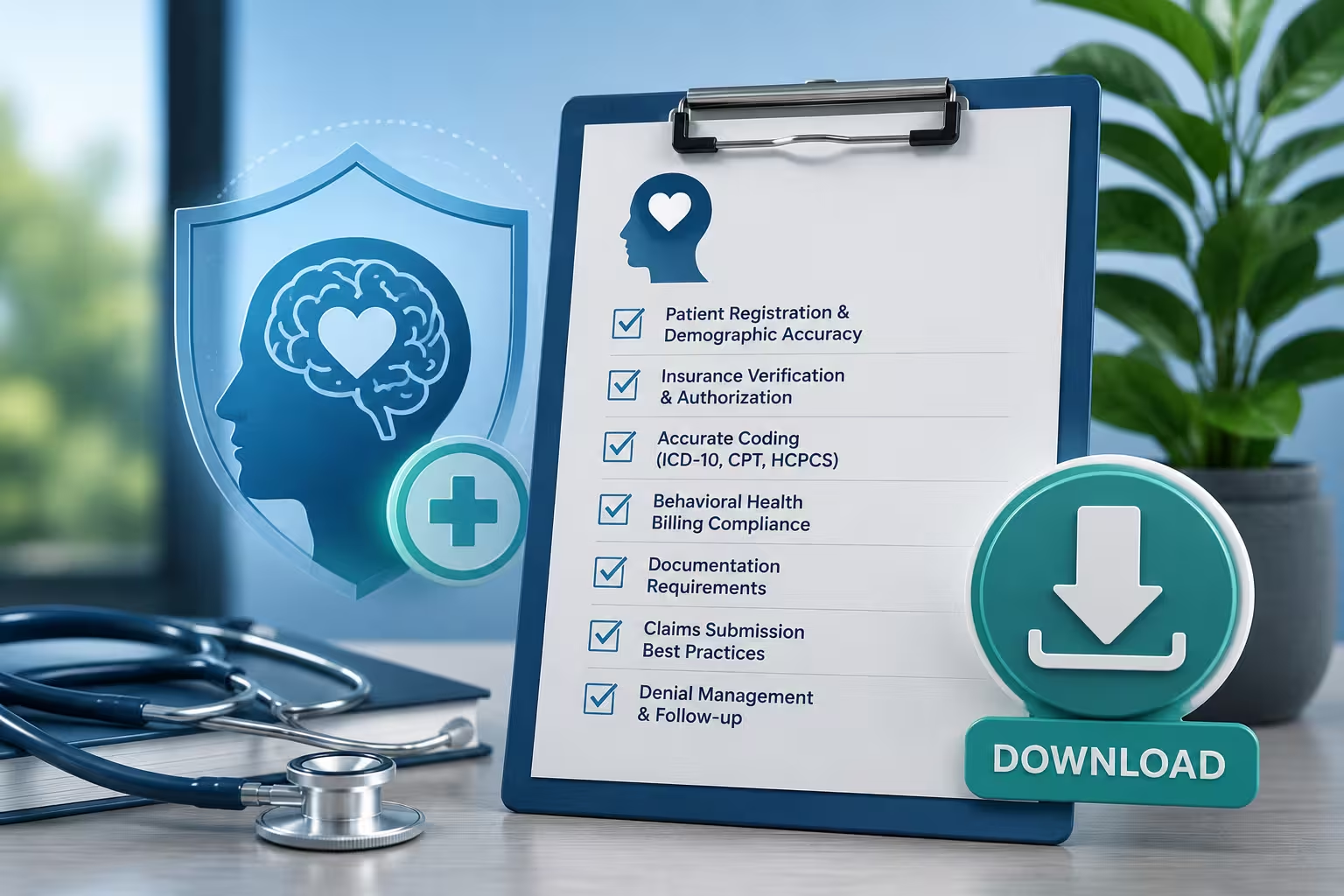
Stop Preventable Mental Health Claim Denials
Most mental health claim rejections happen before the claim reaches the payer. Download our free Pre-Billing Verification Checklist to catch these errors in under 5 minutes before submission.
DOWNLOAD THE CHECKLISTPrior Authorization for Mental Health Services in Wisconsin
Prior authorization (PA) is the process of getting approval from the payers before rendering some services to determine whether it is medically appropriate and evidence-based care. In case of mental health services getting prior authorization is more complex because their requirements vary by payers, diagnosis and treatment plan.
Wisconsin's Major Mental Health Payers and Their PA Requirements
| Payer | Prior Authorization Requirement |
|---|---|
| ForwardHealth (Wisconsin Medicaid) | The majority of mental health and substance abuse services do not require PA, only for some higher-intensity services we need PA before providing the services. |
| Medicare | Routine outpatient psychotherapy generally does not require PA. |
| TRICARE Prime | No PA is not required for office based out-patient mental health visits. |
| Cigna Wisconsin | No PA is not required for psychotherapy or office-based behavioral health visits. However, for higher levels of behavioral health care, inpatient psychiatric admissions and residential treatment we need to get PA. |
| Anthem Blue Cross Wisconsin | It provides a Wisconsin-specific precertification lookup tool so providers can verify whether a particular CPT/HCPCS code requires authorization. |
Steps for getting Prior Authorization for Mental Health Services in Wisconsin
Step 1: Call the insurance company and verify whether the patient needs prior authorization for mental health services before the first appointment. Step 2: If needed request for prior authorization (typically 48–72 hours before service). Step 3: Get authorization reference number and document details like: Authorization reference number Number of sessions approved Duration of authorization (3 months, 6 months, ongoing) Effective date and expiration date Any special conditions (e.g., "requires progress note every 10 sessions")
Step 4: File the authorization documentation along with the patient’s chart. Step 5: Always submit the claims with accurate authorization reference number.
Mental Health Parity Compliance in Wisconsin
The Mental Health Parity and Addiction Equity Act (MHPAEA) is federal law requiring insurance plans that offers mental health services to cover them with the same benefits as medical services. In plain terms, suppose an insurance plan doesn't require prior authorization for medical office visits, then it can't require prior authorization for mental health office visits.
Copays for mental health services must be equal to copays for medical services Deductibles must apply equally (can't have a separate mental health deductible) Prior authorization requirements must be equivalent (not more restrictive) Coverage limits must be equivalent (can't limit mental health visits if medical visits are unlimited) If the health plan provides out-of-network benefits than coverage must be equivalent
Telehealth and Virtual Mental Health Billing in Wisconsin
Telehealth mental health services expanded significantly during COVID-19. Wisconsin has permanently allowed telehealth for behavioral health services with reimbursement rates equal to in-person services.
Telehealth Billing Rules for Wisconsin
ForwardHealth (Wisconsin Medicaid)
Telehealth reimbursement rate = in-person rate Place of service code: POS 02/POS 10 (telehealth, live video interaction) Requires patient consent and documented informed consent in medical record Billing modifier: None required
Commercial Insurance (UnitedHealth, Anthem, etc.)
Mostly cover telehealth mental health services Reimbursement typically = in-person rate Some plans require specific place of service codes
Medicare Telehealth Guidelines
Certain mental health services are offered under Medicare telehealth Use the applicable place of service codes ➢ If the patient is located outside Wisconsin during a telehealth visit, verify the payer coverage for interstate telehealth ➢ Wisconsin telehealth services must be thoroughly documented in the medical record in the same manner as face-to-face services. ➢ Provider must be licensed in Wisconsin to provide telehealth to Wisconsin residents. ➢ Wisconsin state law requires heightened confidentiality for mental health records. So, check whether your telehealth platforms meet the HIPAA/privacy requirements. ➢ Educate the patient about the telehealth risks (privacy, confidentiality, technology failures) and document their consent. Without a valid documentation of patient’s consent telehealth claims might be denied or flagged for compliance review.
How Shoreline Approaches Wisconsin Mental Health Billing
Our Mental Health Billing Process
Front-End Insurance Verification (Pre-Service)
Before every patient's appointment we conduct:
Real-time insurance verification to check the eligibility, copay & deductibles. Check for PA requirement with specific payer contact Document all verification findings in the patient's chart Alert the clinician if PA is required before service
Prior Authorization Management
We handle PA requests proactively, 48–72 hours before service (or same-day if needed) and document the reference numbers in billing system. We track every session to prevent authorization overage. We setup automatic recertification requests at 80% of authorization usage.
Diagnosis Code Optimization
Our computer aided coding software helps to verify whether the clinical documentation includes required specificity (severity, remission status, features) and assign the most specific diagnosis code possible along with cross-checking them against the payer's clinical guidelines. We conduct monthly internal coding audits to identify the specificity errors and correct them.
Documentation Quality Review
We conduct a pre-billing review of clinical notes for completeness, flagging and incomplete notes back to clinician for completion.
Claim Submission with Proactive Error Prevention
Our AI-powered claim validation engine checks every mental health claim against Wisconsin payer rules before submission. It verifies the specificity of the diagnosis code, prior authorization reference numbers, place of service codes and parity compliance in real-time. This "catch-before-submit" approach eliminates the most preventable denial triggers, ensuring claims reach ForwardHealth and commercial payers clean on the first attempt.
Denial Management Specific to Mental Health
With the help of Artificial Intelligence, we track every denial and categorizes each of them by root cause (coding vs. authorization vs. compliance). Our tool automatically flags high-risk patterns and routes for claim correction and resubmission. We've seen visible results of mental health denial rates dropping about 25-35% within the first 90 days of partnering with us.
Compliance Monitoring
Our quarterly compliance audits track the clinician licenses and credentials and also scans for mental health parity violations. This helps us to identify the risks before they become audit findings. We also maintain a full audit trail documenting every corrective action. This proactive stance helps us to keep your practice protected and positioned for successful ForwardHealth surveys.
We, Shoreline Medical Billing Company is driving the future of revenue cycle management with AI automation and expertise. With an expert-led team handling the complete diagnosis code optimization, prior authorization workflows, parity compliance audits and denial management we help mental health services in Wisconsin to stabilize their revenue cycle while staying audit ready.