

With the Centers for Medicare & Medicaid Services (CMS) transitioning to updated risk adjustment frameworks and states heavily modernizing their managed care contracts, Medicaid Managed Care Organizations (MCOs) and healthcare providers are facing a pivotal paradigm shift. Reimbursement is no longer determined simply by the volume of patients seen; it is directly tethered to capturing the comprehensive clinical complexity and burden of illness of each patient profile.
A single missed diagnosis, an under-documented chronic comorbidity, or incomplete encounter data can drastically suppress a practice's risk profile score, leading to substantial underpayment and heightened vulnerability during state and federal Medicaid Risk Adjustment Data Validation (RADV) audits. In this comprehensive guide, we examine how state risk models function, how to establish bulletproof MEAT compliance, and how specialized RCM partners like Shoreline Medical Billing empower practices to thrive under value-based Medicaid contracts.
1 What Is Risk Adjustment in Medicaid?
Risk adjustment is an actuarial calculation methodology used by state Medicaid agencies and Managed Care Organizations (MCOs) to adjust capitation payments based on the predicted health expenditures and illness severity of enrolled beneficiaries. The fundamental objective is twofold:
-
Equitable Plan Compensation: Ensuring that Medicaid MCOs caring for sicker, more vulnerable populations receive higher capitated payments to cover their higher resource utilization.
-
Mitigating Adverse Selection: Preventing health plans from selectively enrolling healthier, low-cost individuals while avoiding high-risk patients with complex chronic diseases.
When a provider submits complete, specific ICD-10 diagnostic codes supported by robust clinical documentation, those encounter records generate an accurate member risk score. If documentation lacks specificity or chronic conditions are omitted during annual visits, the calculated risk score drops artificially, penalizing both the plan and the provider in risk-bearing arrangements.
2 State-by-State Medicaid Risk Model Comparison
Unlike Medicare Advantage—which strictly operates under the uniform CMS-HCC (Hierarchical Condition Categories) model—state Medicaid programs have the autonomy to choose, customize, and deploy different risk adjustment systems. Below is a comparative breakdown of the major models utilized nationwide:
| Risk Adjustment Model | Primary States Utilizing Model | Core Focus & Clinical Grouping Logic | Key Coding Considerations |
|---|---|---|---|
| CDPS (Chronic Illness & Disability Payment System) | California, Nevada, Washington | Categorizes diagnoses into major body systems with hierarchical sub-categories ranging from low to extra-high cost impact. | Requires precise mapping of adult and pediatric chronic disabilities, psychiatric conditions, and prescription drug (CDPS+Rx) categories. |
| CRG (Clinical Risk Groups) | New York | Categorizes patients into mutually exclusive categorical health statuses based on historical inpatient, outpatient, and pharmacy claims. | Heavily emphasizes acute vs. chronic severity tiers, organ system failures, and multi-morbidity interactions. |
| ACG (Adjusted Clinical Groups) | Maryland, Minnesota | Assesses total disease burden through diagnostic clustering and expected morbidity patterns across a calendar year. | Tracks age, gender, diagnostic persistence, and pharmacy utilization to forecast inpatient hospital admissions. |
| State-Specific Hybrid Frameworks | Texas, Florida, Ohio, Illinois | Blends modified CMS-HCC algorithms with state-customized pediatric, maternal health, and behavioral weightings. | Demands rigorous integration of Social Determinants of Health (SDOH Z-codes) and specialized maternal-fetal risk markers. |
Because clinical classifications and weight coefficients vary significantly between CDPS, CRG, and hybrid frameworks, coding teams must know the exact risk model governed by each state Medicaid payer to prevent revenue discrepancies.
3 How Medicaid Differs from Medicare in Risk Adjustment
While both programs share the underlying philosophy of risk-adjusted financing, the operational mechanics and demographic focus of Medicaid differ dramatically from Medicare:
Medicaid Decentralization
Medicaid is state-administered. Each state's Medicaid agency establishes its own risk adjustment methodologies, data submission timelines, encounter validation rules, and audit thresholds.
Varies across CDPS, CRG, ACG, and state hybrid formulas Audit oversight handled by individual state MCO contracts
Maternal, Pediatric & Behavioral Focus
While Medicare is predominantly geriatric (65+ and ESRD), Medicaid covers high volumes of pediatric patients, pregnant mothers, and individuals with severe behavioral health disorders.
Heavy reliance on pediatric disability categories (CDPS) Direct incorporation of Social Determinants of Health (SDOH)
4 Documentation Standards & MEAT Compliance
For any diagnostic code to be accepted in risk scoring and successfully withstand a state RADV audit, the encounter record must satisfy the gold-standard MEAT criteria:
Monitoring Disease Progression
Documenting disease status, reviewing clinical lab markers, tracking vital trends, imaging findings, or symptom fluctuations over time (e.g., "HbA1c steady at 7.2%", "BP controlled on current regimen").
Evaluating Patient Condition
Reviewing diagnostic test results, assessing therapeutic effectiveness, response to current medications, or examining physiological signs during physical exam.
Assessing Severity & Acuity
Ordering specialized consults, counseling the patient, staging chronic illnesses (e.g., CKD Stage 3b), and explicitly recording clinical stability or worsening.
Treating & Managing
Prescribing medications, adjusting dosages, scheduling surgical or specialist referrals, therapy plans, dietary instructions, or specialized care coordination.
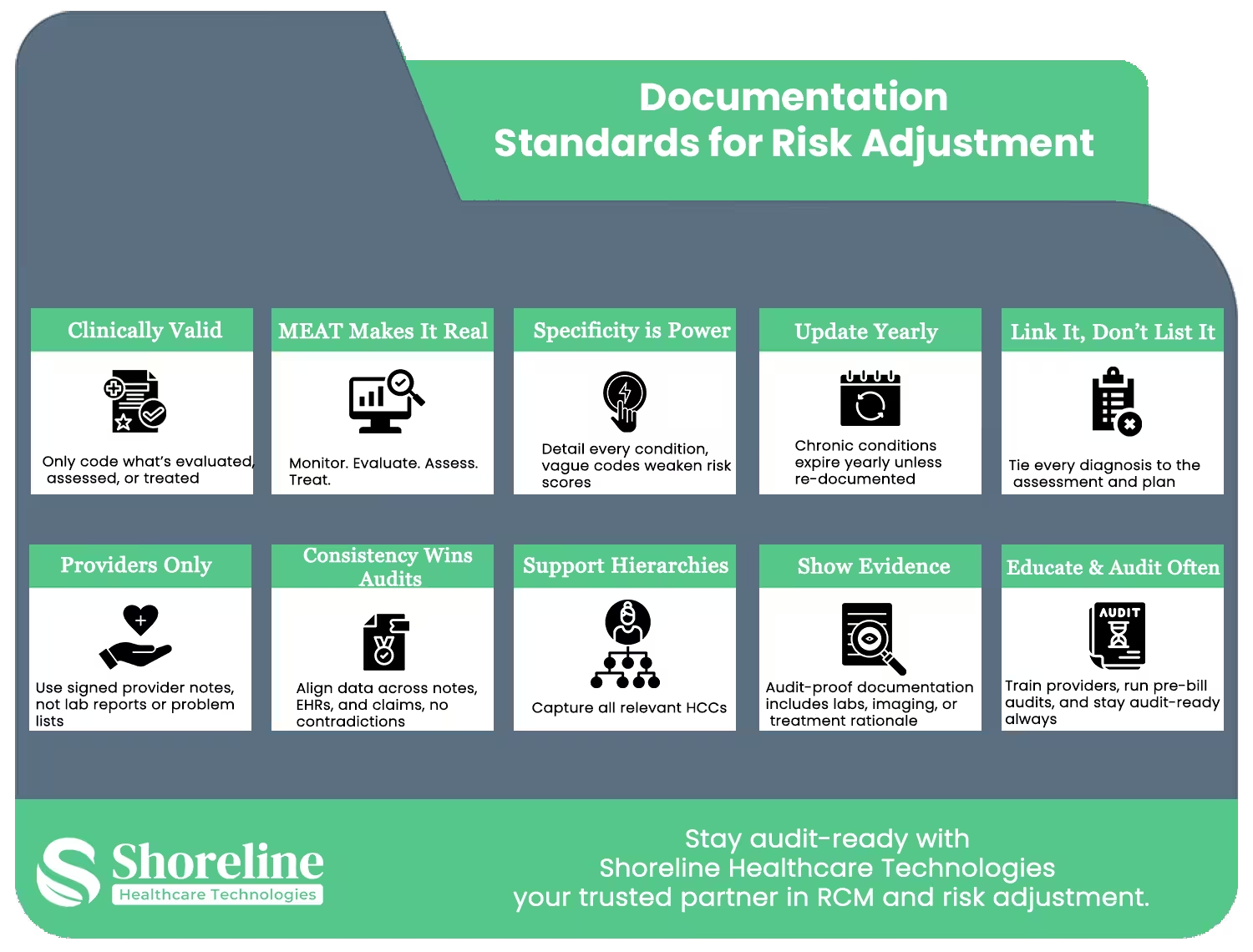
Crucial Coding Tenets to Prevent Risk Adjustment Audits:
-
Credentialed Provider Sign-Off: Only qualified, credentialed healthcare providers (MD, DO, NP, PA) can render diagnoses and sign medical notes with date and timestamp.
-
Annual Chronic Re-Validation: Prevalent conditions like Type 2 Diabetes, Hypertension, COPD, and Major Depressive Disorder must be evaluated and coded at least once every calendar year to remain active in the risk score.
-
Eliminate "History Of" Errors: Never code past, resolved conditions as active diagnoses. History codes (Z85-Z87) do not map to risk scores unless continuous active maintenance therapy is required.
-
EHR Template Hygiene: Audit automated EHR macros and problem lists to ensure inactive or outdated diagnoses do not auto-populate onto encounter claims.
Eliminate Risk Adjustment Gaps & Audit Vulnerabilities
Shoreline's certified coding specialists perform pre-bill chart scrubs, clinical documentation improvement (CDI), and state-specific Medicaid risk score validation.
5 Operational Excellence Through Smarter Workflows
Achieving top-tier risk scoring accuracy requires closing the clinical documentation loop across all three phases of the patient visit:
Pre-Visit Chart Scrubbing
Review historical claims, prior-year chronic condition lists, and lab flags before the patient arrives. Clinicians receive targeted point-of-care alerts highlighting chronic conditions needing annual re-assessment.
Intra-Visit EHR Prompts
Leverage intelligent EHR templates and Natural Language Processing (NLP) prompts that guide clinicians to document MEAT components without disrupting bedside workflow.
Post-Visit Coding Quality Audits
Certified risk adjustment coders (CRC) inspect the full physician note for specificity, stage, and lateral accuracy before claim transmission, eliminating discrepancies before they reach Medicaid MCO payers.
6 Nationwide Scale & Strategic RCM Partnership
Navigating the expanding complexity of state-specific Medicaid risk models requires a partner with demonstrated scale, specialized coding depth, and cutting-edge technology. Shoreline Medical Billing operates across all 50 US states, delivering comprehensive Revenue Cycle Management services tailored to private practices, multi-specialty clinics, FQHCs, and ambulatory centers.
Our end-to-end RCM solutions encompass Eligibility & Benefits Verification, charge capture, ICD-10/CPT/HCC coding, denial management, provider credentialing, and state-level audit defense. By uniting seasoned certified coders with cloud-based analytics, Shoreline safeguards your revenue stream while ensuring uncompromising compliance.