

One of the main struggles of the healthcare industry is maintaining clinical data integrity while providing a secure, high-speed information exchange platform. With cloud data portability, healthcare providers can maintain a decisive competitive advantage, optimize cash flow, and elevate their operational flexibility.
In this article, we examine how understanding and implementing robust interoperability standards enables automated data access, eliminates vendor lock-in, and facilitates secure, compliant clinical transmission across hybrid and multi-cloud environments.
What is Cloud Interoperability?
Cloud interoperability is the capability of diverse software applications, electronic health record (EHR) systems, and specialized cloud services to seamlessly integrate, communicate, and work together for the smooth exchange and utilization of information.
It enables secure, automated data transfers across multiple cloud infrastructure models—including public, private, and hybrid cloud architectures.
- Cross-Environment Data Portability: Enables frictionless migration of structured clinical datasets across public, private, and hybrid clouds.
- Standardized API Interaction: Allows clinical applications, EHRs, and PMS platforms to exchange records via uniform protocols.
- Vendor Lock-in Immunity: Prevents healthcare organizations from being constrained to single-provider proprietary ecosystems.
The concept extends far beyond basic data export. It provides standardized protocols and consistent data structures so that applications hosted on disparate cloud infrastructures can interact dynamically without integration friction or schema distortion.
Why Is Cloud Data Sharing Important?
Healthcare organizations depend fundamentally on real-time, accurate data for both clinical care delivery and revenue cycle operations. Legacy, on-premise silos make it exceedingly difficult to exchange, validate, and synchronize patient information across care venues.
Modern cloud computing eliminates these operational barriers, enabling secure, low-latency data sharing across authorized clinical stakeholders.
- Real-Time Stakeholder Collaboration: Connects physicians, diagnostic laboratories, hospitals, and commercial payers instantly.
- Strict Regulatory Compliance: Aligns with HHS HIPAA & HITECH cloud security mandates.
- Overhead Reduction: Eliminates duplicate storage infrastructure, paper archives, and legacy maintenance costs.
- Machine Learning & AI Enablement: Supplies standardized, normalized datasets to train predictive diagnostic and RCM algorithms.
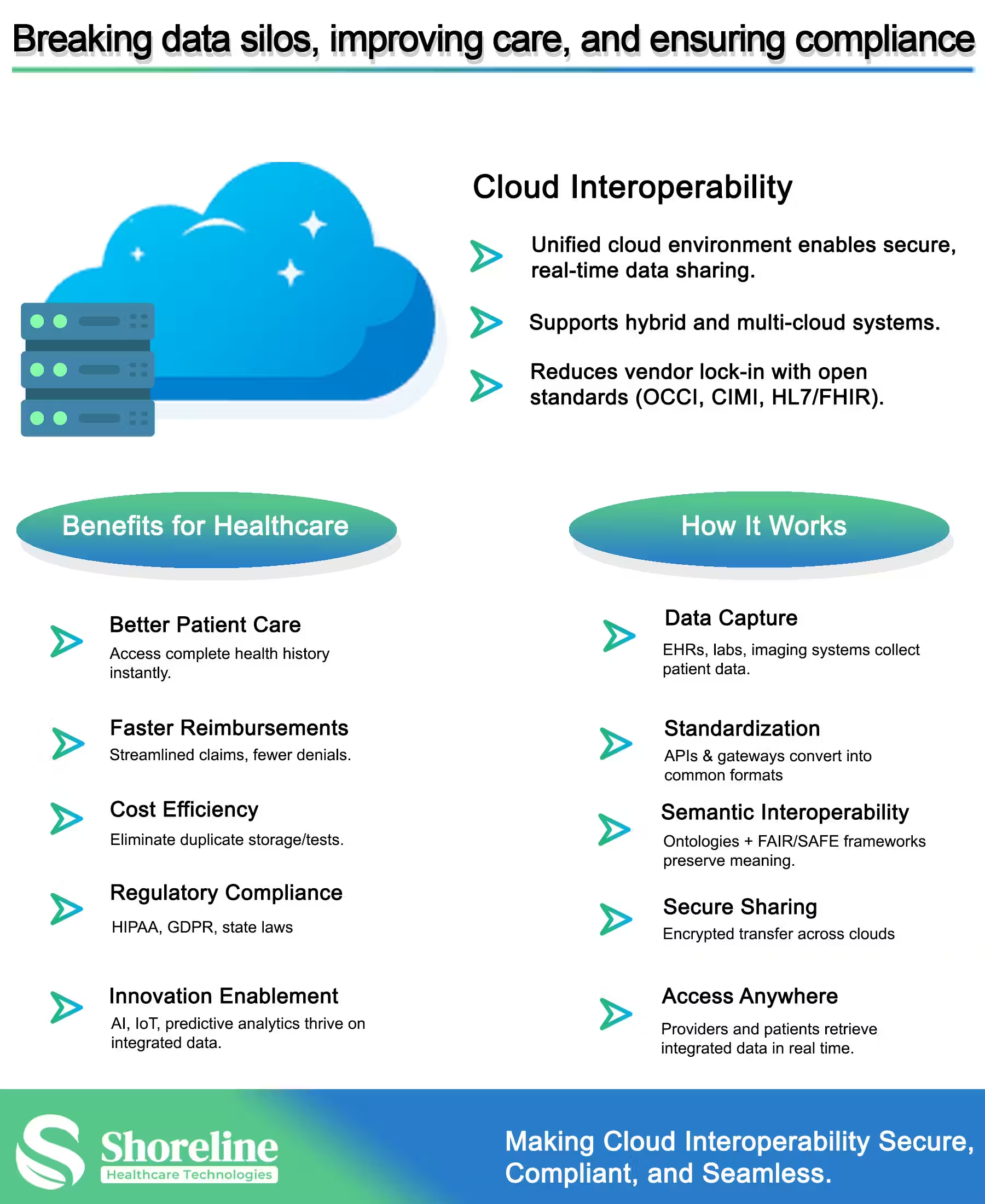
How to Achieve Cloud Data Portability Across Platforms
True data portability across heterogeneous cloud platforms requires adherence to open industry standards, normalized schema specifications, and robust API gateways:
Open Cloud Computing Interface (OCCI)
Developed by the Open Grid Forum, OCCI delivers a comprehensive open specification for managing compute, storage, and networking resources across multi-cloud providers without proprietary tooling constraints. It serves as a foundational bridge for hybrid cloud orchestration.
Cloud Infrastructure Management Interface (CIMI)
CIMI provides standardized infrastructure management across cloud boundaries. It streamlines provisioning, monitoring, and auto-scaling through a unified data model, significantly simplifying workload migrations between public and private clouds.
Standardized Application Programming Interfaces (APIs): RESTful APIs and HL7 FHIR protocols establish deterministic communication channels, providing:
- Consistent Data Exchange Formats: JSON/XML schemas that ensure precise semantic interpretation across EHRs.
- Robust Authentication & Authorization: OAuth 2.0 and SAML protocols securing cross-platform access.
- Workflow Orchestration Standards: Enabling complex clinical workflows to span multiple cloud nodes.
- Metadata Context Preservation: Ensuring clinical notes and diagnostic context remain intact during transmission.
Interoperability in Cloud Computing: Healthcare Benefits
1. Breaking Down Clinical Data Silos
Healthcare facilities routinely operate disparate specialized systems—including EHRs, PACS imaging platforms, LIS lab systems, and billing clearinghouses. Without unified interoperability, data exchanges remain fragmented.
Cloud-based environments provide secure, real-time data exchange platforms, enabling authorized clinicians to access comprehensive longitudinal patient records instantly.
2. Supporting Seamless Continuity of Care
When patient records are accessible in real-time across emergency departments, primary care clinics, and specialty centers, clinical outcomes improve dramatically.
Instantaneous access to updated patient records mitigates treatment delays, eliminates unnecessary repeat diagnostic tests, and fosters greater patient trust.
3. Enabling Multi-Cloud Strategies & Eliminating Vendor Lock-in
Health systems often deploy hybrid multi-cloud configurations—utilizing AWS for AI workloads, Microsoft Azure for clinical data lakes, and private clouds for confidential archives. Interoperability ensures these diverse clouds communicate seamlessly.
Vendor lock-in occurs when a practice becomes overly dependent on a single cloud vendor’s proprietary architecture. Adopting open interoperability standards guarantees:
- Freedom of Selection: Ability to select cloud vendors based on performance, feature set, and cost.
- Risk Diversification: Mitigates disaster risks by eliminating single-point infrastructure dependencies.
- Vendor Leverage: Maintains strong pricing negotiation power with enterprise cloud providers.
- Agile Innovation: Enables rapid integration of best-of-breed health IT solutions.
4. Powering AI & Predictive Revenue Cycle Analytics
Interoperable cloud data models aggregate structured claim feeds and unstructured clinical notes. These unified datasets feed advanced AI engines to generate predictive RCM analytics, flag potential claim denials before transmission, and optimize reimbursement capture.
Why Choose Shoreline Medical Billing Company?
At Shoreline Medical Billing, we provide fully HIPAA-compliant, secure cloud platforms that streamline clinical and financial data exchange for hospitals, group practices, and specialty clinics.
Our team delivers vendor-neutral RCM integration across leading EHR/EMR platforms (Epic, Cerner, AthenaHealth, Kareo, eClinicalWorks) while maintaining 100% compliance with federal and state privacy statutes. We provide 24/7 technical oversight, end-to-end cloud migration support, and proactive denial prevention.
Optimize Your Practice Data Flow & Maximize Reimbursements
Partner with Shoreline Medical Billing to break down data silos, achieve complete cloud interoperability, and accelerate your practice revenue cycle.